A complete guide to earth bond testing, how it works, and when it's needed
You may occasionally see high current earth bond testing mentioned in appliance tester specifications or online forums. But what exactly is a high current bond test? How is it performed, and when is it actually required?
Standard Earth Continuity Testing (200 mA)
Most appliance testers perform an earth continuity test using approximately 200 mA. The purpose of this test is to confirm that the earth conductor resistance is low enough to safely carry fault current caused by insulation failure.
However, resistance alone doesn’t always indicate conductor integrity. For example:
- The earth wire could be partially damaged or about to break.
- The conductor might still measure < 1 Ω and pass a 200 mA test.
- But would it survive a
REAL high-current fault?
This is where standard continuity testing has limitations—and where high current earth bond testing becomes valuable.
What Is High Current Earth Bond Testing?
A high current earth bond test applies a much stronger test current—up to 25 A—through the protective earth conductor. This does two things:
- Verifies earth resistance under load
- Stresses the conductor to assess its structural integrity
The principle is straightforward: if the earth conductor has a weak point, applying high current will cause it to fail (similar to a fuse blowing). A break in continuity results in an open circuit and a clear FAIL result.
Why Isn’t High Current Bond Testing Common?
If the test is useful, why don’t most technicians perform it? There are several reasons:
1. Not Required by AS 3760
AS 3760 does not require high current earth bond testing. The standard is designed around testing procedures that can be completed with simple, lightweight, portable equipment.
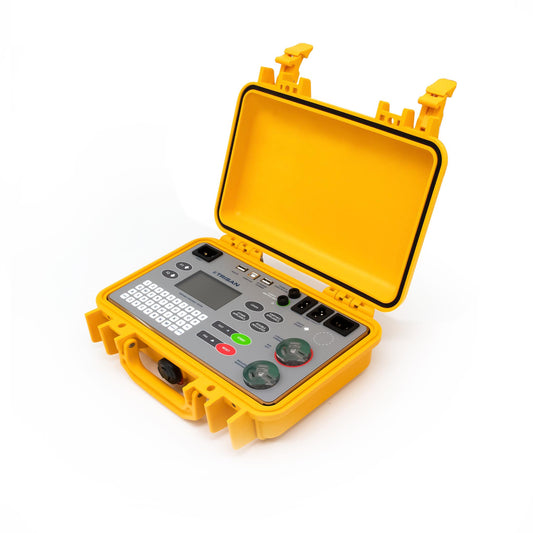
2. Requires Advanced, Expensive Equipment
Delivering 25 A requires:
- Heavy-duty test equipment
- Mains-powered appliances
- Larger and more costly testers
This is impractical for most test and tag technicians who prefer compact, battery-operated testers.
3. Potential Risk to Sensitive Equipment
There is a higher risk of damage to IT equipment during a high current test. For example, accidentally placing an earth probe on a signal earth such as a USB port can lead to equipment damage.
When Is High Current Earth Bond Testing Used?
High current bond testing may be:
- Required in specific industry standards or engineering specifications
- Used in manufacturing QA processes
- Performed on heavy-duty industrial equipment where earth integrity is critical
However, for most technicians operating under AS 3760, it’s unlikely you’ll need this type of test or own the equipment required to carry it out.
The Bottom Line
High current earth bond testing provides a more complete assessment of the earth conductor’s strength and reliability, but it is not part of AS 3760 requirements and is generally used only in specialised industries. For everyday test and tag work, standard 200 mA earth continuity testing remains the accepted method.